| |
Eulogy for Jeff D. Chalk III
September 22, 2017
Highland Park Presbyterian Church
By Philip C. Chalk
On behalf of my mother and the rest of my family, I want to thank everyone who is here this afternoon for taking the time to join us in remembering my father. In the different versions of his obituary, as well as in the nice, little profile that appeared this week in the Dallas Morning News, he has been recalled first as a scientist and a professor, and I am sure he would have liked that. Even before he was a husband or a father, Jeff D. Chalk III had his heart stolen—during his undergraduate years at Rice—by what he liked to describe as the “musical” nature of mathematics in high-energy physics. It was the mid-20th century, at what may well have been near the peak of cultural confidence in the methods and promise of the western natural sciences—and it especially was a “golden age” for theoretical physics. With it, Dad fell headlong in love and remained so for life.
He was a kind of scientist’s scientist, closely attentive to methods and proofs, only too aware of how human scientific inquiry can be, and usefully skeptical when it really mattered. Some of you may recall that In 1989, two chemists in Utah announced that they had managed to cause and sustain nuclear fusion in a university laboratory, and for a day or so, media reports were full of enthusiastic portraits of a future in which energy was limitless and free. Even scientists interviewed on network news programs were caught up, and I hadn’t heard a single skeptical opinion before that first day came to an end and I got the chance to ask Dad what he thought.
“Oh, I don’t believe it,” I remember him saying, and when I asked why, he explained firstly what would be required simply to contain a real fusion reaction. By the end of the following day, that kind of skepticism had become the consensus, and the whole episode was quickly forgotten as another case of wishful scientific thinking and dashed hopes. The same thing happened again recently, in 2011, when researchers in Switzerland and elsewhere claimed to have tracked a neutrino traveling faster than the speed of light. There was a burst of enthusiastic speculation as to what this could mean for cosmological models and so on, but Dad dismissed it from the beginning. “That would throw into question the entire Einsteinian portrait of the universe,” he told me. “The math in that is just too strong — too convincing. I think they just made a mistake.” He turned out to be right.
If you want to see what I mean about about how impressively counter-intuitive this kind of judgment could be, look up sometime how many web sites and online “experts” insist in the most confident manner that running burns more calories than walking. No, it doesn’t, said Dad: The work required to travel a mile is the same regardless of the speed, though there is a slight variance in that high runners do lift themselves higher off the ground with each step. You may sweat more and even lose body mass more quickly when running, but that isn’t the same thing as burning calories, he’d explain, because calories aren’t units of mass—they’re units of energy.
So, Dad was a smart guy, and his intelligence enriched the lives of those around him. I should mention, though, that all that learning made him an easy target, and he was always a good sport about it. My wife would tell him “Sure, Dave, I’ll be happy to program your VCR for you” or “Here, let me show you how to use the microwave,” after which she would ask, “But, I mean, don’t you have a PhD in physics?” And he would just laugh.
Remembering my father’s great love for scientific inquiry makes for good copy, but it’s only a mere part of his real story—and to be honest, it isn’t why we’re all here today. Those of us who knew and loved him had many reasons of our own, reasons peculiar to each of us. But there was one certain thing about my father that I think had an almost universal appeal: There was about him a kind of stubborn innocence, a resolute and conscious disavowal of cynicism in a cynical time. Dad was able to invest himself fully in all of life’s enriching moments, big and small, one after another, and his principal affections—especially for the love of his live, his wife of sixty years, Sarah—were unalloyed and palpably heartfelt. Going to sleep in their bedroom a couple of months ago, he told my mother in the darkness, “I hope when we’re in Heaven we’ll be together.” Those words from someone else might ring faIse and seem sacchrine, but not from him. If Dad felt it, he said it, and he meant what he said.
Sometime after the death of his own father in the mid-1980s, my father became—improbably, given his own parents—a hugger. And more than that: A hugger who said, “I love you.” This was conscious on his part and probably an acquired skill, but once he started, he never stopped. The hugs and the words were an unchecked expression of his feelings; you would never doubt them.
The New York Times columnist David Brooks wrote a few years ago that “About once a month I run across a person who radiates an inner light. These people can be in any walk of life. They seem deeply good. They listen well. They make you feel funny and valued. You often catch them looking after other people and as they do so their laugh is musical and their manner is infused with gratitude. They are not thinking about what wonderful work they are doing. They are not thinking about themselves at all.”
This wonderfully describes my father, and I think that is why this room has as many people in it this afternoon as it does. If my father were here — if only he were here — he would want every one of you to know how much you meant to him. He would encourage you in your hopes and struggles, remind you of how talented and capable you are and how lucky others would be to hire or meet or work with you. And there would be an awful lot of hugs. He would be happy to know that he was being remembered for his love of science, but he would be even happier to know that his memory was being celebrated for the love and friendship that he shared so gratefully and for so many, fortunate years, with all of you.
Amen.
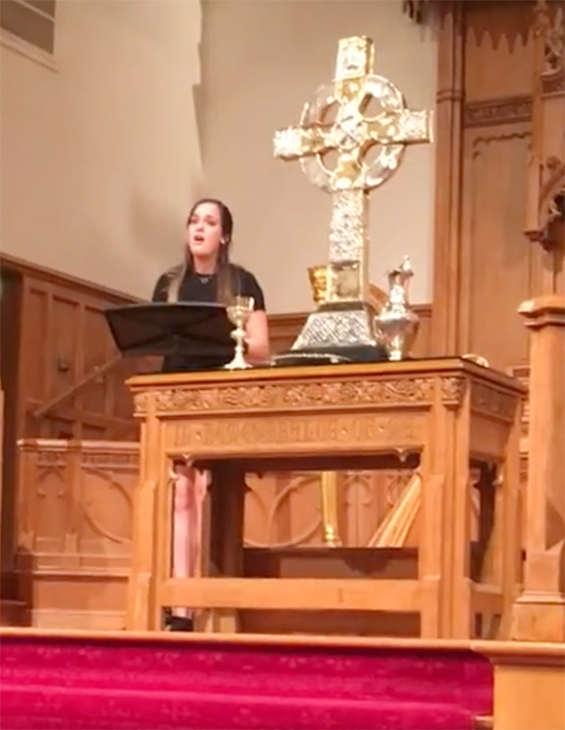
Click on this image or here to hear Jeff D. Chalk’s grandaughter Madeleine Chalk sing “Be Thou My Vision” at his 2017 funeral. (Link opens in YouTube.) |
|
|